She spent three decades being underestimated and kept winning anyway. On November 3, 2026, Keisha Lance Bottoms became the first woman and the first Black woman ever elected governor of Georgia, and the first Black woman governor in American history.
ATLANTA. The news broke just before eleven, and the room did what rooms do when history arrives without asking permission: it went quiet, then it went loud. On the night of November 3, 2026, Keisha Lance Bottoms became the first woman and the first Black woman ever elected governor of Georgia, and the first Black woman elected governor in the history of the United States. She is fifty six years old.
She has spent her entire adult life preparing for a night like this one, even in the years when almost no one else believed it would come. She defeated Republican Rick Jackson, a billionaire health care executive endorsed by President Trump, in a race much of the political class had written off as a reach.
Her victory ends more than twenty years of Republican control of Georgia's statehouse, the longest such stretch in modern Georgia politics, and hands Democrats the governorship of the most closely divided battleground in the country.
HER MOMENT
The moment did not arrive by accident. It was assembled, piece by piece, over three decades.
Bottoms grew up in Atlanta as the daughter of Major Lance, the rhythm and blues singer whose 1963 hit “The Monkey Time” made him a star and whose later years taught his daughter early that public life is not always kind. She earned her undergraduate degree at Spelman College, one of the great Black women's institutions in America, and her law degree at Georgia State University. She served as a magistrate judge in Fulton County. She sat on the Atlanta City Council.
In 2018 she was elected mayor of the city that raised her. Her four years as mayor were, by any honest accounting, among the hardest any Atlanta mayor has faced. She led the city through a pandemic that emptied downtown, through a national reckoning over policing that began in Minneapolis but burned through Atlanta's own streets, and through the relentless scrutiny that comes with being a Black woman in charge during a crisis. She chose not to seek a second term.
Her opponents later used that decision against her, spending millions on advertisements claiming she had abandoned the city. Voters, it turns out, had watched the same four years and reached a different conclusion. President Biden brought her to Washington as director of the Office of Public Engagement, where she spent two years translating the concerns of ordinary Americans into the language of the West Wing.
When she returned to Georgia to run, she carried endorsements from both President Biden and former President Barack Obama, and a conviction that the distance between the statehouse and the people who live under its laws had grown too wide.
HER MISSION
Ask Bottoms what the job is for and she does not reach for abstraction. She wants the state income tax eliminated for public school teachers, a proposal that sounds like tax policy and is really a statement about who Georgia claims to value.
She supports a moratorium on new data centers, a position that puts her at odds with some of the state's most powerful economic voices and squarely alongside the families watching their water tables and their electricity bills rise. Her campaign rarely strayed from a single idea: that education is the most reliable ladder a state can build, and that Georgia had been quietly sawing through its own rungs. That idea is not rhetorical for her. Her family's story runs through classrooms. Her career runs through them.
When she talks about the teachers who shaped her, she is not reaching for a talking point. She is naming people.
HER LEGACY
The legacy began before she took the oath. Bottoms' victory came on a night when Georgia elected eight Black women to statewide office, a result that will reshape not only who governs the state but who is assumed to belong in the rooms where the governing happens. For a generation of Georgia girls, the word governor will now arrive with a face attached to it.
That is a change no policy brief can measure and no opponent can repeal. It is also a change with weight attached. Every first carries a double load: the work of the office and the work of proving the office can hold someone like you. Bottoms has said plainly that she understands the assignment. She has spent her public life being underestimated, and she has spent it winning anyway. On the night of the victory, surrounded by her family, she called it an honor. Honor is the right word, and it is not the whole story.
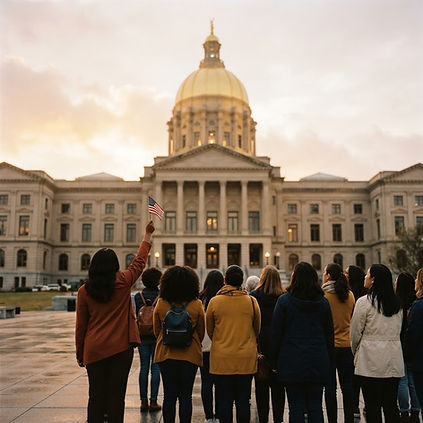
What happened in Georgia was not a gift. It was a long, deliberate climb out of a city council chamber, a courtroom, a pandemic, and a season of doubt, ending at the steps of a gold domed building where no woman had ever stood as its chief executive. Her moment is here. Her mission is on the desk waiting for her. And her legacy, the part that will outlast every headline from this week, has already begun to walk through doors that were locked when she was born.
Published in The History Issue